
Daily Operations, Observations and Oddities at Cair Paravel Farm.
We now have a new "tab" feature just below our e-mail subscription bar. Now you can explore our farm, meet the inhabitants, check the weather, and reserve our BnB with a click of the mouse!
Don't forget to follow us by e-mail! Enter your address below and hit the return key to have new posts sent directly to your inbox.
Showing posts with label Livestock. Show all posts
Showing posts with label Livestock. Show all posts
Tuesday, May 22, 2012
Welcome Back
Hello all! After a very lengthy absence, I am back from my journey abroad. I have traveled just shy of 11,000 miles through the lower 48 states in seven weeks, and have never been happier to be home! Needless to say, there is an overwhelming amount of stuff that has happened in my absence. I'm going to do my best to get all caught up. In the meantime, enjoy this adorable video of one of our lambs chasing the geese. Yes, the lamb is new; and yes, an introduction is due.


Friday, March 2, 2012
Barn Awning
We're always looking for more ways to make our animals more comfortable. All of the renovations we've been working on recently have had that end goal in mind. One great feature about our barn is that the entire south facing side is completely open to the outside. This is ideal in the summer and really allows the air to flow freely through the barn helping keep down mold and mildew, as well as keep our animals cool. However, in inclement weather the open face of the barn can prove more of a problem. We set out to devise a plan to help keep water, snow, and cold out of the barn during rainy and/or wintery weather.
Here's what we came up with!


Healthy goats and sheep can handle the cold very well, however it's the wind that can cause the most harm to an animal trying to stay nestled for warmth. The tarpaulin is the perfect (and inexpensive) solution. Not only does it keep the wind from whipping through and chilling the livestock to the bone, but it keeps horizontal rain and snow drifts out as well. It was important to make sure the outside wall design was modular so we didn't lose the best aspect of the barn in the warmer months, but durable enough to withstand the mountain winters. A simple pulley system allows the tarps to be rolled up, essentially turning them into huge blinds. We're pleased with the design and the barn stays much warmer now even on the coldest of nights. The water containers are frozen less frequently than before. Feel free to click on the above pictures for a more detailed look at the tarp and pulleys!
Here's what we came up with!


Healthy goats and sheep can handle the cold very well, however it's the wind that can cause the most harm to an animal trying to stay nestled for warmth. The tarpaulin is the perfect (and inexpensive) solution. Not only does it keep the wind from whipping through and chilling the livestock to the bone, but it keeps horizontal rain and snow drifts out as well. It was important to make sure the outside wall design was modular so we didn't lose the best aspect of the barn in the warmer months, but durable enough to withstand the mountain winters. A simple pulley system allows the tarps to be rolled up, essentially turning them into huge blinds. We're pleased with the design and the barn stays much warmer now even on the coldest of nights. The water containers are frozen less frequently than before. Feel free to click on the above pictures for a more detailed look at the tarp and pulleys!
Wednesday, February 29, 2012
Coop Swap!!
We've recently swapped coops! Here is what our old chicken coop looked like, we used five gallon buckets as the laying nests for convenience and ease of cleaning. The chickens seemed to like them too!
 However, our flock has grown and we are anticipating it continuing to grow during this summer. So, we've re-worked our horse stalls as part of the overall barn remodel to
become the new coop for our laying hens, turkeys, and guinea hen. You can see the direct access that the birds have outside through the small doors in the barn wall. We close these up every night to keep them safe from outside predators.
However, our flock has grown and we are anticipating it continuing to grow during this summer. So, we've re-worked our horse stalls as part of the overall barn remodel to
become the new coop for our laying hens, turkeys, and guinea hen. You can see the direct access that the birds have outside through the small doors in the barn wall. We close these up every night to keep them safe from outside predators.
 The new coop is four times the size of the old one which really gives the birds some more room to move around. We tried to make the transition between coops as low stress as possible, but unfortunately right after the initial swap, our egg production dropped down to a mere
few eggs a day. We were worried about this drop and started trying to figure out how to increase the egg production in other ways. Luckily all that the chickens seemed to need was time. After having two or three weeks to become
accustomed to the new space, the eggs are booming! We get about two and a half to three dozen fresh eggs a day!
The new coop is four times the size of the old one which really gives the birds some more room to move around. We tried to make the transition between coops as low stress as possible, but unfortunately right after the initial swap, our egg production dropped down to a mere
few eggs a day. We were worried about this drop and started trying to figure out how to increase the egg production in other ways. Luckily all that the chickens seemed to need was time. After having two or three weeks to become
accustomed to the new space, the eggs are booming! We get about two and a half to three dozen fresh eggs a day!
 |
| You can see the wall on the back of the coop was painted by Martha, trying to use up some old house paints. I think that the chickens enjoyed the murals, maybe we can do it again in the new space this spring! |

 |
| You can see some different nesting boxes on the walls in this picture. We still used the five gallon buckets for other nesting boxes and those are located along the opposite wall to these boxes. |

Here are the chickens enjoying their new space!
Monday, February 27, 2012
Barn Remodel
We've been busy in 2012! It's only February and there has already been SO MANY things added to our to-do list, gotten underway, already completed, or soon to become project numero uno. One top priority was the barn. It was in desperate need of a good organizing and ultimately a remodel to best suit our and the animal's needs. Unfortunately, I did not have the forethought to take some "before" pictures prior to picking up the hammer and having at it, so enjoy only the "after" shots.
Moving in the direction of having goats and sheep as our primary herd animals, it was necessary to build pens for them. We also don't want to only accommodate the animals we have currently, but allow for expansion and have a place to put little ones, interim goats b/w the time they are born and the time they find a new home, and any other animals we may need a place for. Accommodating the animal's needs is one thing, but we also need the barn to suit our needs for storage, influx of livestock, ease of feeding and watering, and ultimately easier upkeep and ability to keep the barn clean. We decided to go with a lane design for the barn. Essentially this just means that an aisle is set right down the middle of the barn with animal pens on each side. This way when it's time to clean, we can muck everything into the center lane and then scrape it all out at once as opposed to having to hand shovel and wheel barrow every last bit of manure and used bedding. Our barn was already set up perfectly for this design since it has two big bay doors that open on the west facing side.
Moving in the direction of having goats and sheep as our primary herd animals, it was necessary to build pens for them. We also don't want to only accommodate the animals we have currently, but allow for expansion and have a place to put little ones, interim goats b/w the time they are born and the time they find a new home, and any other animals we may need a place for. Accommodating the animal's needs is one thing, but we also need the barn to suit our needs for storage, influx of livestock, ease of feeding and watering, and ultimately easier upkeep and ability to keep the barn clean. We decided to go with a lane design for the barn. Essentially this just means that an aisle is set right down the middle of the barn with animal pens on each side. This way when it's time to clean, we can muck everything into the center lane and then scrape it all out at once as opposed to having to hand shovel and wheel barrow every last bit of manure and used bedding. Our barn was already set up perfectly for this design since it has two big bay doors that open on the west facing side.
 | ||
| Here you can see the lane that goes straight back to the sliding bay doors. Each pen has two doors into the lane. Each door can be opened into the lane and secured to create one large pen from the front to the back of the barn allowing for even more flexibility in the use of the barn! |
 | ||
| Eglantine and Rosie happy in their own pens! |
 |
| Here is the milking pen, which also doubles as our birthing pen since it has better lighting mounted directly over head. |
 |
| Two additional pens on the backside of the barn. |
 |
| Here are the two bays used for tractor implement storage. |
 |
| Here are two bays being used for hay storage. |
 |
| A look down the lane from the opposite side of the barn. |
 |
| We've added gravel to the backside of the barn. Soon this whole area will have a roof over it for the dual purpose of covering our processing area, and allowing for storing our tractor out of the elements. For the time being we store the tractor in the barn by the hay storage. |
Monday, January 30, 2012
The Boys Are Back In Town
Our three boys have been busy! Last fall we let The Damon out with Eglantine and Rosie to see if he couldn't do his duty as the herd sire. Turns out, he accomplished the task!
We're proud to announce that Eglantine and Rosie are both pregnant with TWINS!!
We didn't have The Damon breed with Kikki or Eva. Kikki was still weening Eva at the time, and Eva is much too young to have kids. Even though she is physically able to have kids, there are a lot of complications associated with a tiny goat getting pregnant. So to be on the safe side, we kept Kikki and Eva inside on the big day.
 |
| The Damon: proud soon-to-be daddy goat! |
 |
| Sammy: excited to have more (hopefully) does around. |
 |
| Starlight |
Friday, January 27, 2012
Starlight

For the passed several months, we have been graced with the presence of Starlight! Star (for short) is a beautiful championship pedigreed
Lincoln Longwool English Ram decsending from 5 generations of champions. He was about 8 months old when he arrived to our farm all the way from Ithaca,
NY. Our friend Malou Stark purchased Starlight at the Maryland Fiber Festival in May and they immediately bonded. After purchase, Malou
drove to NY to pick him up farther upstate along the Canadian border
in a small town called Brennan where he was brown. We've brought Star to
our flock to breed with our ewes! If all goes well, we will be
expecting lambs in the spring!


Starlight's only visiting our farm for a short time, so if you haven't had a chance to meet him yet, come on up for a visit! I know you'll find him to be the most pleasant ram you've ever met.
Wednesday, December 14, 2011
Thanksgiving: In Review!
Thanksgiving this year was a fun-packed weekend-long undertaking filled with incredible food, awesome friends and family, warm fires, and merriment. Whitt and Martha had the usual suspects up for Thanksgiving dinner aside from Grethcen and Austin. Unfortunately they were unable to make it up from Asheville, NC.
The meal consisted of three (yes, three!) of our turkeys prepared in different ways. Two birds had been brined by Mia and Martha prior to cooking: one in a water and salt mixture, the other in a mixture of water, milk, salt, and various spices. The third was relatively untouched prior to cooking. The idea behind brining is that the salt and liquid mixture will coat the skin and form a protective coating that holds in the moisture of the bird while being cooked with minimum basting required. The two brined birds were grilled while the third was cooked as normal in the oven. Howard and Whitt spear-headed the grilling of the turkeys.


According to all present, every bird was unbelievable, but the grilled birds where exceptionally good. Of course the birds were merely the center piece to the meal. All of the sides and desserts were also, as normal, incredible.
The meal consisted of three (yes, three!) of our turkeys prepared in different ways. Two birds had been brined by Mia and Martha prior to cooking: one in a water and salt mixture, the other in a mixture of water, milk, salt, and various spices. The third was relatively untouched prior to cooking. The idea behind brining is that the salt and liquid mixture will coat the skin and form a protective coating that holds in the moisture of the bird while being cooked with minimum basting required. The two brined birds were grilled while the third was cooked as normal in the oven. Howard and Whitt spear-headed the grilling of the turkeys.
 |
 |
| Howard sprinkling on some magic. |

 |
| A couple swipes of goodness... |
 |
| And viola! |
 |
| Whitt and Howard talking about the boring view. |

 |
| In goes the bird! |
 |
| Annie doing one last nose check before the lid is closed to make sure it smells good. |
Monday, December 12, 2011
This Is Ground Control to Major Tom
 Hello blog followers!
As many of you may have expected, the holidays on top of our regular work schedule have been swallowing us whole. Thanksgiving is always a blast at the farm because not only do we celebrate on Thursday, but we also have Thanksgiving Pt. II! The barn was in dire need of a re-vamping with the influx of animals in need of storage. I'm glad to say we have finished most of that project up. We've been able to get Christmas trees, decorate for the season, throw a holiday party, host lot's of visitors, AND rent a ram to breed our ewes. Needless to say, the blog will not be neglected for the next few weeks.
There's so much to tell you about! Stay tuned!
-Brendan and the whole Cair Paravel Family!
Monday, November 21, 2011
Get Your Turkey!
Thanksgiving is on Thursday! If you don't know where your turkey is coming from, we have the solution!
We still have a limited quantity of birds left that have not been reserved for the big day. All of our birds are heritage breed, grass fed, organic Bourbon, Narragansett, and Palm turkeys. Turkeys were processed on Sunday (11/20) and are sold un-frozen. It's as fresh as they come!
Remember to buy local and support small businesses this holiday season!
We still have a limited quantity of birds left that have not been reserved for the big day. All of our birds are heritage breed, grass fed, organic Bourbon, Narragansett, and Palm turkeys. Turkeys were processed on Sunday (11/20) and are sold un-frozen. It's as fresh as they come!
$5.50/lb --- weights vary.
If you're in need of a last minute turkey, e-mail Cair Paravel at
CPARAVEL@GMAIL.COM with "TURKEY" in the subject line.
Remember to buy local and support small businesses this holiday season!
Tuesday, November 8, 2011
Herding the Flock
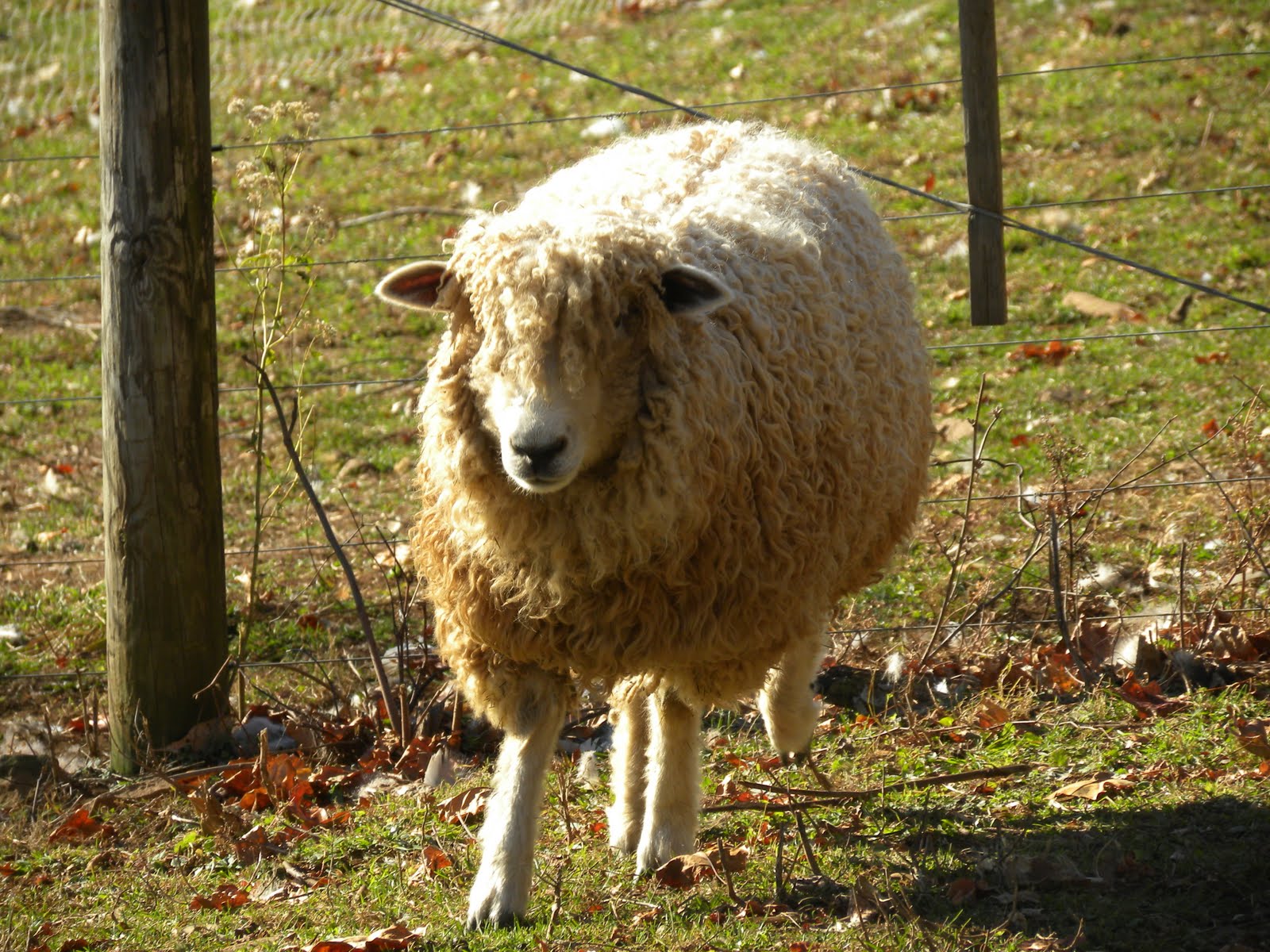
Down at the barn Mikey hears me call, "Sheeeep, here sheeep." He is always the first to come thinking he is going to get a treat!

Flora, resting in the shrubs this warm day decides to join... but maybe not...but sees Noelle ambling up with Mikey.

Noelle and Mikey realize they are going to the green pasture. The area around the barn has been nibbled to nubs so they are going out to the stockpiled fescue, red clover, and landino clover pasture. There is also browse for them along the meadow edges.

Mikey, of course was the first to get into the knee deep grasses however....

.....the rest did not lag behind! Herding this trio is not difficult. Just show them food and they will follow.
See how the great grazing has help the sheep produce fantastic fleece!
 This is Mikey's long-stapled white locks...
....and Noelle's creamy brown that deepens into dark chocolate.! I am looking forward to working with the wool this winter.
Chicken Processing
Coming up this Sunday, November 13, 2011 the last 2011 chicken processing (plus a few roosters and some geese. If you want to help/learn come and join us. Set up will start at 9:00 AM.
Friday, October 21, 2011
Goat For Sale, Trade, or Barter
CPE needs a new home for Samuel! Samuel is a very happy and healthy purebred Nubian buck born July 6th, 2011. He has been de-horned and will soon be ready for breeding.
What we are looking for:
-outright sale of Samuel for a price TBD
-trade for other livestock (i.e.-goats, sheep, turkeys, et cetera)
-a mutually beneficial trade of breeding services
-establish a network between ourselves and another goat farm
We would love to talk and work out some sort of deal that can benefit us and the buyer. We're more interested in starting a relationship with other goateries than a plain cut and dry exchange of money.
If you would like more information, please contact us through e-mail at cparavel@gmail.com.

What we are looking for:
-outright sale of Samuel for a price TBD
-trade for other livestock (i.e.-goats, sheep, turkeys, et cetera)
-a mutually beneficial trade of breeding services
-establish a network between ourselves and another goat farm
We would love to talk and work out some sort of deal that can benefit us and the buyer. We're more interested in starting a relationship with other goateries than a plain cut and dry exchange of money.
If you would like more information, please contact us through e-mail at cparavel@gmail.com.

Wednesday, October 19, 2011
Eva Update!
I'm pleased to inform little Eva's leg has healed beautifully! For those
that may not remember, she broke her leg a few weeks after she was born
and had to hobble around with a cast. Now the cast is off and her leg
isn't giving her any issues at all!


Friday, October 7, 2011
Egglentine and Damon, Sittin' In A Tree...
The Damon has become sexually mature! This is great for us because it means we are now able to increase our herd. Kikki is too fresh from her previous pregnancy to be bred, but Egglentine and Rosie aren't.
The bad part about male goats is 100% related to their sexual maturity. As a means of attracting females, bucks urinate on their own face and hump everything in their path. Apparently the stinkier the goat, the more appealing he is to the ladies. The stink aspect is also true with female goats. It's rather unmistakable when a doe is in heat.
All gross-ness aside, Egglentine has been showing signs of being ready to mate, so we've put her and The Damon together. Boy...it is hilarious.
The bad part about male goats is 100% related to their sexual maturity. As a means of attracting females, bucks urinate on their own face and hump everything in their path. Apparently the stinkier the goat, the more appealing he is to the ladies. The stink aspect is also true with female goats. It's rather unmistakable when a doe is in heat.
All gross-ness aside, Egglentine has been showing signs of being ready to mate, so we've put her and The Damon together. Boy...it is hilarious.
Here is what we humans see of the interaction:
However, I feel if we were to see this through the eyes of a goat,
the struggle for Eggie's heart would look much more like this.
the struggle for Eggie's heart would look much more like this.
So, hopefully if everything goes according to plan, we will be welcoming a few more goats to our herd come springtime! I will keep you posted!!
Wednesday, September 21, 2011
Turkeys Are Not Chickens, Right?
We have a hilariously confused turkey hen on our hands. She's taken to roosting with our Americana chickens! The birds on both sides of specie don't seem to mind. The turkey hen takes care of sitting on the eggs (yes, ALL of the eggs chicken and turkey alike) and the chicken even cuddle up underneath the turkey for warmth. It's great to see them snuggling in the tractor during the day. What a great example of a symbiotic relationship! Good work birds! Keep working together!
 If you look closely, you can see the chicken's backside sticking out from
underneath the turkey's right wing.
 If you look closely, you can see the chicken's backside sticking out from
underneath the turkey's right wing.
Friday, September 16, 2011
Goose Update!
 The geese are growing up strong! It's fun to see the difference between the little gray fuzz balls and the plumage they end up having. Turns out a lot of our chics are the same type of goose as Mary! (Mary is one of our original geese that is a lot less obnoxious than the others.) We've moved them back into the barnyard so they are now able to socialize with the other animals.
Remember to think of Cair Paravel for you Christmas Goose this holiday season!
Wednesday, September 14, 2011
Bobcats
Unfortunately we've lost some of our turkeys to the wild. The bird's propensity to refuse being contained within the safety of the electro-net barrier finally caught up to them. Every night during lock up I would find six to eight turkeys running in circles around the turkey enclosure incredibly confused as to how exactly they managed to escape, while simultaneously being desperate to get back in with the other turkeys. I would chase all of the birds back into the surround only to find the same birds loose the next morning.
We came up with a solution to this mess, however the day Whitt and I went down to correct the issue the middle pasture was covered in turkey feathers and turkey parts. It was horrible. I found one complete turkey, one turkey without a head, one head (only), and one right wing. Due to the manner in which the birds were killed and the fact that most of the victims were dragged off of the property seems to point towards bobcats, but of course we are unsure.
Unfortunately it's hard to say I didn't see this coming. We've taken a huge blow to our turkey supply, however it's a great learning process about how to raise free range birds for meat rather than easy prey for predators.
We came up with a solution to this mess, however the day Whitt and I went down to correct the issue the middle pasture was covered in turkey feathers and turkey parts. It was horrible. I found one complete turkey, one turkey without a head, one head (only), and one right wing. Due to the manner in which the birds were killed and the fact that most of the victims were dragged off of the property seems to point towards bobcats, but of course we are unsure.
Unfortunately it's hard to say I didn't see this coming. We've taken a huge blow to our turkey supply, however it's a great learning process about how to raise free range birds for meat rather than easy prey for predators.
Monday, August 29, 2011
Chicken Processing
We processed our first batch of birds this season! 16 chickens, and one turkey. It was my first experience with killing any sort of animal bigger than a mosquito, so needless to say I was a bit squeamish during the first few birds. By the end of the day the whole process became rather interesting. I'll spare you the more gruesome pictures, so no need to be nervous while scrolling down. There will be some blood and chicken parts in regards to the "before & after" aspect, but nothing you haven't seen in the meat section of your grocer.
We set up the processing station at the back side of the barn. In the future we will have a legit setup with a concrete slab and a roof over everything to keep the rain and sun out, but for now (since it's our first at-home processing) we needed a place with electricity and water; a.k.a. the barn. Taking a bird from the field to the table is comprised of three steps:
2) Feather Plucking

Plucking the feathers by hand is a difficult, time consuming, irritating process. Luckily with a bit of ingenuity, we were able to put together a "Whiz-Bang Chicken Plucker™." The plucker comes in a kit consisting of an electric motor, reduction gear, and all the rubber fingers necessary. The rest is up to the builder to decide the design best fit for the operation. It was rather fun building the machine with Whitt and I must say it turned out beautifully. I'll be posting an entry all about how we built the plucker for those who are interested, but for now you get to see it in action! Here is a picture of the plucker.
The actual plucking process is comprised of two steps. First, we dunk the bird into hot soapy water (146˚F). The soap helps the water penetrate the feathers and reach the skin ultimately loosening the feathers. After the dunk, it's into the plucker they go! The plucker can handle up to four birds, depending on their size. The sides of the machine are stationary while the base spins, causing the plucking action to occur. The feathers all come off and head down a shoot where they are collected for compost. Check out the videos below to see the whole process in real-time!

Now, here's where things get interesting. After plucking, the heads and feet are removed. This was my job. We saved the feet to make chicken stock, the heads we composted. From there the birds go into a cool water bath to bring the temperature down. Out of the cool water bath the necks are removed as well as the internals. Mia and Martha took care of this process. We saved the necks to be added to the chicken stock, and Mia and Martha delicately located and removed the chicken livers to make paté hors d'oevures. After the bird has been completely eviscorated, into an ice bath they go for 24 hours. The ice bath cools the birds and gets them ready for packaging and freezing.
 Mia and Martha at work!
 Mia removing the entrails.
 Martha doing the final inspection before placing the
birds in the white cooler full of ice behind her.
We set up the processing station at the back side of the barn. In the future we will have a legit setup with a concrete slab and a roof over everything to keep the rain and sun out, but for now (since it's our first at-home processing) we needed a place with electricity and water; a.k.a. the barn. Taking a bird from the field to the table is comprised of three steps:
1) The Kill

There are different schools of thought about how to dispatch a bird. Anything from a simple chop to the neck, to electrically shocking the birds to stun them. We practice the simplest and most humane way with the use of "kill-cones" to allow the bird to bleed out as quickly and painlessly as possible. With the use of this technique, the bird is asleep in six seconds. For our setup, we used traffic cones and widened the opening at the top to accommodate the size of the bird being processed. (i.e.-different cones for chickens vs. turkeys vs. geese, et cetera.) Here is our setup pictured to the left. It's important to catch the runoff so that Aslan doesn't acquire a taste for chickens, but mostly because it is very rich in nutrients and can be put into our gardens to help fertilize.

There are different schools of thought about how to dispatch a bird. Anything from a simple chop to the neck, to electrically shocking the birds to stun them. We practice the simplest and most humane way with the use of "kill-cones" to allow the bird to bleed out as quickly and painlessly as possible. With the use of this technique, the bird is asleep in six seconds. For our setup, we used traffic cones and widened the opening at the top to accommodate the size of the bird being processed. (i.e.-different cones for chickens vs. turkeys vs. geese, et cetera.) Here is our setup pictured to the left. It's important to catch the runoff so that Aslan doesn't acquire a taste for chickens, but mostly because it is very rich in nutrients and can be put into our gardens to help fertilize.
2) Feather Plucking

Plucking the feathers by hand is a difficult, time consuming, irritating process. Luckily with a bit of ingenuity, we were able to put together a "Whiz-Bang Chicken Plucker™." The plucker comes in a kit consisting of an electric motor, reduction gear, and all the rubber fingers necessary. The rest is up to the builder to decide the design best fit for the operation. It was rather fun building the machine with Whitt and I must say it turned out beautifully. I'll be posting an entry all about how we built the plucker for those who are interested, but for now you get to see it in action! Here is a picture of the plucker.
The actual plucking process is comprised of two steps. First, we dunk the bird into hot soapy water (146˚F). The soap helps the water penetrate the feathers and reach the skin ultimately loosening the feathers. After the dunk, it's into the plucker they go! The plucker can handle up to four birds, depending on their size. The sides of the machine are stationary while the base spins, causing the plucking action to occur. The feathers all come off and head down a shoot where they are collected for compost. Check out the videos below to see the whole process in real-time!
3) Evisceration

Now, here's where things get interesting. After plucking, the heads and feet are removed. This was my job. We saved the feet to make chicken stock, the heads we composted. From there the birds go into a cool water bath to bring the temperature down. Out of the cool water bath the necks are removed as well as the internals. Mia and Martha took care of this process. We saved the necks to be added to the chicken stock, and Mia and Martha delicately located and removed the chicken livers to make paté hors d'oevures. After the bird has been completely eviscorated, into an ice bath they go for 24 hours. The ice bath cools the birds and gets them ready for packaging and freezing.
 Mia and Martha at work!
 Mia removing the entrails.
 Martha doing the final inspection before placing the
birds in the white cooler full of ice behind her.
And there you have it! For more pictures (including the more graphic pictures) of this or any other happenings on the farm, feel free to visit our blog photo album here!
Subscribe to:
Posts (Atom)