Translate Our Page!

Showing posts with label production. Show all posts

Wednesday, February 29, 2012

Coop Swap!!

We've recently swapped coops!  Here is what our old chicken coop looked like, we used five gallon buckets as the laying nests for convenience and ease of cleaning. The chickens seemed to like them too!

You can see the wall on the back of the coop was painted by Martha, trying to use up some old house paints. I think that the chickens enjoyed the murals, maybe we can do it again in the new space this spring!
However, our flock has grown and we are anticipating it continuing to grow during this summer. So, we've re-worked our horse stalls as part of the overall barn remodel to become the new coop for our laying hens, turkeys, and guinea hen. You can see the direct access that the birds have outside through the small doors in the barn wall. We close these up every night to keep them safe from outside predators.
You can see some different nesting boxes on the walls in this picture. We still used the five gallon buckets for other nesting boxes and those are located along the opposite wall to these boxes.
 The new coop is four times the size of the old one which really gives the birds some more room to move around. We tried to make the transition between coops as low stress as possible, but unfortunately right after the initial swap, our egg production dropped down to a mere few eggs a day.  We were worried about this drop and started trying to figure out how to increase the egg production in other ways. Luckily all that the chickens seemed to need was time. After having two or three weeks to become accustomed to the new space, the eggs are booming! We get about two and a half to three dozen fresh eggs a day!


Here are the chickens enjoying their new space!

Monday, February 27, 2012

Barn Remodel

        We've been busy in 2012! It's only February and there has already been SO MANY things added to our to-do list, gotten underway, already completed, or soon to become project numero uno. One top priority was the barn. It was in desperate need of a good organizing and ultimately a remodel to best suit our and the animal's needs. Unfortunately, I did not have the forethought to take some "before" pictures prior to picking up the hammer and having at it, so enjoy only the "after" shots.

        Moving in the direction of having goats and sheep as our primary herd animals, it was necessary to build pens for them. We also don't want to only accommodate the animals we have currently, but allow for expansion and have a place to put little ones, interim goats b/w the time they are born and the time they find a new home, and any other animals we may need a place for. Accommodating the animal's needs is one thing, but we also need the barn to suit our needs for storage, influx of livestock, ease of feeding and watering, and ultimately easier upkeep and ability to keep the barn clean. We decided to go with a lane design for the barn. Essentially this just means that an aisle is set right down the middle of the barn with animal pens on each side. This way when it's time to clean, we can muck everything into the center lane and then scrape it all out at once as opposed to having to hand shovel and wheel barrow every last bit of manure and used bedding. Our barn was already set up perfectly for this design since it has two big bay doors that open on the west facing side.

Here you can see the lane that goes straight back to the sliding bay doors.
Each pen has two doors into the lane. Each door can be opened into the lane
and secured to create one large pen from the front to the back of the barn
allowing for even more flexibility in the use of the barn!


Eglantine and Rosie happy in their own pens!


Here is the milking pen, which also doubles as our birthing pen
since it has better lighting mounted directly over head.


Two additional pens on the backside of the barn.

Here are the two bays used for tractor implement storage.

Here are two bays being used for hay storage.

A look down the lane from the opposite side of the barn.

We've added gravel to the backside of the barn. Soon this whole area will have a roof
over it for the dual purpose of covering our processing area, and allowing for storing
our tractor out of the elements. For the time being we store the tractor in the
barn by the hay storage.

Monday, October 10, 2011

Tomætoes, Tomátoes

    Martha has picked the last of the tomatoes before the gardens are switched to fall/winter mode. With the nights getting colder, and ultimately the day's temperatures catching up, that means it's time to break out the green house structures for the raised beds and move as much as we can into the affixed greenhouse off of the lower apartment. I've been working on tilling all of this years plants into the soil to decompose and nourish the ground. As a good way to end the time of year that the bulk of our veggie production slows down by sharing some pictures of the different tomato varieties we grew this year.


    Our tomatoes were good to us this year!

Wednesday, October 5, 2011

Sauerkraut Has Finished!

    Yesterday was an exciting day.  The sauerkraut we had started back in July has finally been jarred, and we were able to taste the incredible-ness that is fresh sauerkraut. 

    Now, to put my amazement into perspective, I thought sauerkraut from a can you buy at the store was incredible.  I would have to refrain from buying it because I'd end up putting it on everything -- i.e. hot dogs, bratwursts, sandwiches, corn flakes, et cetera.  However, now I don't think I'll ever want to buy canned sauerkraut from the store again.  It would only make me cry that it wasn't home-made with every bite.  I can't exactly put my finger on why the fresh kraut is so much better, it just is.


 The canning process.


 Mmmmmmmm...


Martha at work!

    For all you sauerkraut lovers out there, try and make it up for some reubens, or brats, or some corn flakes smothered in kraut with us!

Monday, September 26, 2011

Sauerkraut

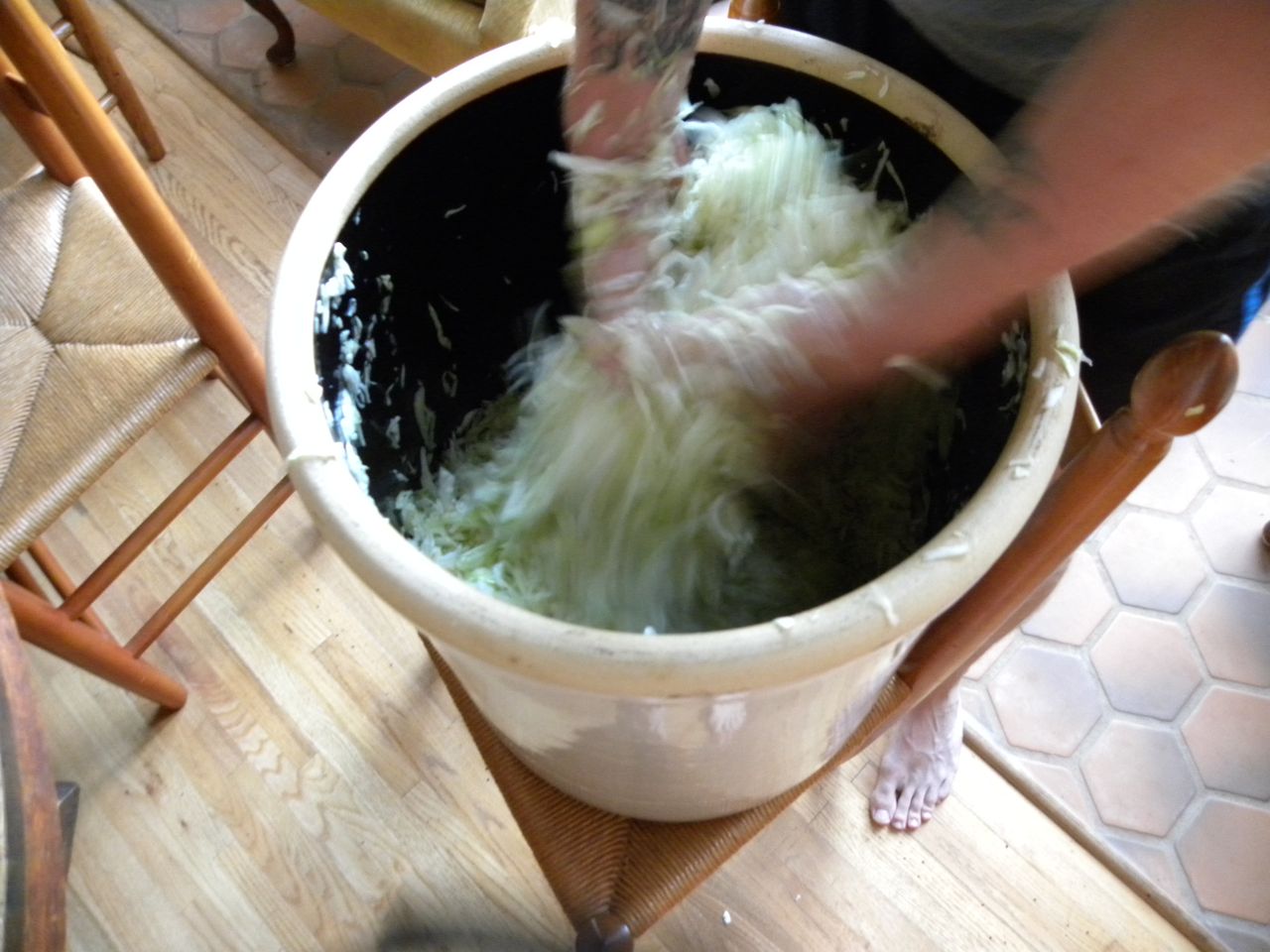
We've made our own sauerkraut! Martha seasoned up a huge amount of cabbage with the appropriate ingredients used to make sauerkraut and I got the pleasure of mixing it all together in a large clay pot.


After the cabbage mixture has all been blended together, it goes into the basement to ferment and become incredible! We made this mixture back in July and it has been marinating ever since. We are getting ready to can the kraut very soon! Stay tuned for a post about the finished product!

Monday, September 19, 2011

Market Baking


The Greene Co. Farmer's Market was a blast this year! I'm sure you all saw Martha's updates on Facebook about what was being sold. The farmer's market season has ended in Greene with the school's opening up, so in order to get a hold of our delicious baked goods, you'll have to contact us directly for the time being. Remember, as always these items are available when you stay at our bnb! We do have some prospects for having local markets sell limited quantities of our breads and baked goods, but at this time it is very tentative. I will keep you up to date as more info is available. In the meantime, anybody want a muffin?


Monday, August 29, 2011

Chicken Processing

We processed our first batch of birds this season! 16 chickens, and one turkey. It was my first experience with killing any sort of animal bigger than a mosquito, so needless to say I was a bit squeamish during the first few birds. By the end of the day the whole process became rather interesting. I'll spare you the more gruesome pictures, so no need to be nervous while scrolling down. There will be some blood and chicken parts in regards to the "before & after" aspect, but nothing you haven't seen in the meat section of your grocer.

We set up the processing station at the back side of the barn. In the future we will have a legit setup with a concrete slab and a roof over everything to keep the rain and sun out, but for now (since it's our first at-home processing) we needed a place with electricity and water; a.k.a. the barn. Taking a bird from the field to the table is comprised of three steps:

1) The Kill


There are different schools of thought about how to dispatch a bird. Anything from a simple chop to the neck, to electrically shocking the birds to stun them. We practice the simplest and most humane way with the use of "kill-cones" to allow the bird to bleed out as quickly and painlessly as possible. With the use of this technique, the bird is asleep in six seconds. For our setup, we used traffic cones and widened the opening at the top to accommodate the size of the bird being processed. (i.e.-different cones for chickens vs. turkeys vs. geese, et cetera.) Here is our setup pictured to the left. It's important to catch the runoff so that Aslan doesn't acquire a taste for chickens, but mostly because it is very rich in nutrients and can be put into our gardens to help fertilize.


2) Feather Plucking


Plucking the feathers by hand is a difficult, time consuming, irritating process. Luckily with a bit of ingenuity, we were able to put together a "Whiz-Bang Chicken Plucker™." The plucker comes in a kit consisting of an electric motor, reduction gear, and all the rubber fingers necessary. The rest is up to the builder to decide the design best fit for the operation. It was rather fun building the machine with Whitt and I must say it turned out beautifully. I'll be posting an entry all about how we built the plucker for those who are interested, but for now you get to see it in action! Here is a picture of the plucker.

The actual plucking process is comprised of two steps. First, we dunk the bird into hot soapy water (146˚F). The soap helps the water penetrate the feathers and reach the skin ultimately loosening the feathers. After the dunk, it's into the plucker they go! The plucker can handle up to four birds, depending on their size. The sides of the machine are stationary while the base spins, causing the plucking action to occur. The feathers all come off and head down a shoot where they are collected for compost. Check out the videos below to see the whole process in real-time!


3) Evisceration


Now, here's where things get interesting. After plucking, the heads and feet are removed. This was my job. We saved the feet to make chicken stock, the heads we composted. From there the birds go into a cool water bath to bring the temperature down. Out of the cool water bath the necks are removed as well as the internals. Mia and Martha took care of this process. We saved the necks to be added to the chicken stock, and Mia and Martha delicately located and removed the chicken livers to make paté hors d'oevures. After the bird has been completely eviscorated, into an ice bath they go for 24 hours. The ice bath cools the birds and gets them ready for packaging and freezing.

Mia and Martha at work!


Mia removing the entrails.


Martha doing the final inspection before placing the
birds in the white cooler full of ice behind her.


And there you have it! For more pictures (including the more graphic pictures) of this or any other happenings on the farm, feel free to visit our blog photo album here!

Tuesday, August 25, 2009

You Have to Start Somewhere

Cair Paravel Enterprises is not a new idea, years ago (I'm sure I'll be told the exact date later) we operated selling chicken eggs...and other products? I honestly cannot remember, being the little tyke that I was, however I remember milking goats, shearing sheep, eating lamb and chicken from the farm, picking and canning, canning CANNING.

Here we are again.

Right now our production is limited to what we can spare, which is mostly eggs. The layers are contributing about 1.5 dozen a day, with a miscellany of yoke and shell issues. (Yesterday mom made pasta with a double-yolk egg and one of the hens laid a membrane-wrapped egg white. No shell. No yolk.) Eventually we hope to have fresh produce not only for ourselves* but for those interested in sustainable, organic (abet uncertified), oft-heirloom and above all DELICIOUS offerings-of-the-garden. I'm still trying to convince The Managers (ne Parents) to get milk goats or a heritage breed of cow for milk and meat. Dad (or Whitt, or Chef Ledford) will have some beautiful woodwork to offer after the summer work season, and hopefully will be able to offer some cooking classes in the near future. The sisters plan to eventually sell their products: artwork, clever crafts, and essential tools of life....


But for now, we're eggs and apartment rentals. For the record, the chickens incontrovertibly came first here.


- Lil

*78 quart jars of whole Romas have been canned
I forget how many jars of sauce, sauerkraut, dillybeans
endless bags of green beans are in the freezer, nestling with peaches
Heirloom tomatoes are being dried and frozen, apples too
We have enough pesto to float a pasta battleship.